
Justice, moral courage, and the responsibility of a living Faith in an age of institutionalized injustice
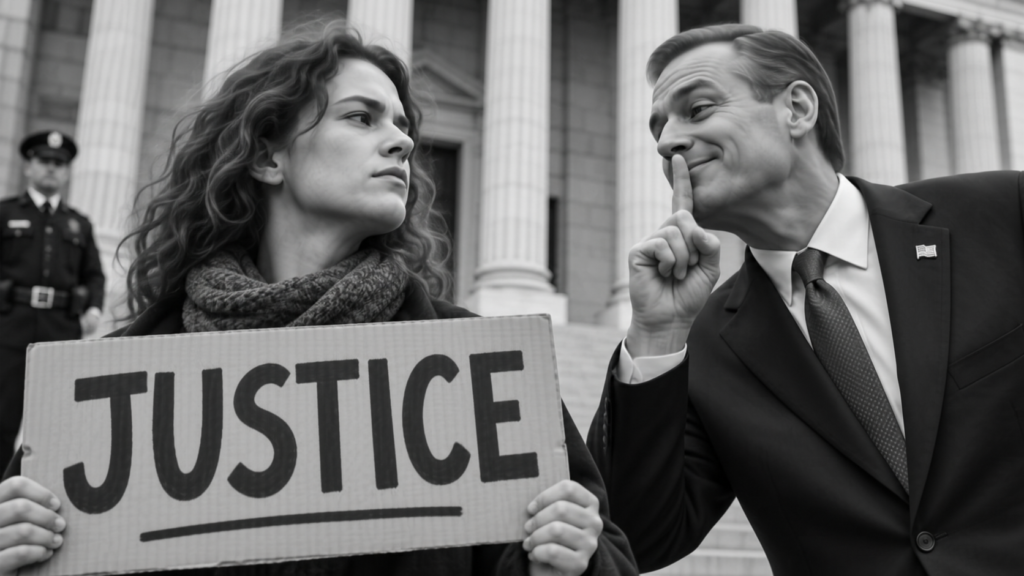
One of the greatest dangers facing any religious tradition is that its teachings can become interpreted in ways that inadvertently protect the very forms of injustice they were intended to overcome. Principles originally intended to promote peace, unity, and human dignity can, when applied without sufficient discernment, become instruments of conformity and submission to corrupt authority.
This danger is particularly relevant to the Bahá’í Faith, whose Founder, Bahá’u’lláh, placed justice at the very center of His Revelation.
In The Hidden Words, Bahá’u’lláh declares:
“The best beloved of all things in My sight is Justice; turn not away therefrom if thou desirest Me.”
Justice, then, is not a secondary consideration. It is among the fundamental requirements of spiritual life and the foundation of a healthy civilization.
Yet a serious question arises when the Bahá’í principles of obedience to government, non-involvement in partisan politics, unity, and civility are interpreted so broadly that they discourage meaningful resistance to institutionalized injustice.
What happens when government itself becomes an instrument of oppression? What happens when laws protect the powerful at the expense of the vulnerable? What happens when appeals to social stability and civility are used to silence those demanding accountability?
And perhaps most importantly, what happens when the moral outrage of those witnessing injustice is treated as a greater problem than the injustice itself?
When Civility Becomes a Weapon
Civility is ordinarily understood as a virtue. Courtesy, restraint, respect, and consideration for others are essential to constructive human relationships. Bahá’u’lláh repeatedly emphasized the importance of these qualities, encouraging His followers to avoid hatred, contention, and abusive speech.
But civility can also be weaponized.
In political life, appeals to decorum are sometimes employed to deflect attention from wrongdoing. A public official may engage in deception, corruption, or the abuse of power, yet those who confront that conduct forcefully are accused of being divisive, disrespectful, or inflammatory.
The focus shifts from the wrongdoing to the emotional response of those who object to it.
The person exposing injustice becomes the problem. The anger of the oppressed is treated as more objectionable than the conduct that provoked it. Calls for unity become demands for silence, and appeals to moderation become mechanisms for preserving the status quo.
This is the weaponization of civility: the transformation of a genuine moral virtue into a means of protecting power from accountability.
Such an application of civility is difficult to reconcile with the example of Bahá’u’lláh Himself.
In His Tablets to the kings and rulers of the world, Bahá’u’lláh did not hesitate to confront those in positions of authority. He condemned oppression, warned rulers against abusing their power, and reminded them of their responsibility toward the people entrusted to their care.
He did so without abandoning dignity or courtesy. But His courtesy never required Him to conceal injustice or soften the moral seriousness of His message.
His example demonstrates that respect for the humanity of those exercising authority does not require deference to their wrongdoing.
Courtesy concerns how we treat people. Justice concerns how we respond to their actions. Neither principle should be permitted to extinguish the other.
The Difference Between Authority and Justice
Bahá’u’lláh’s teachings strongly emphasize obedience to just government and the preservation of social order. These principles serve an important purpose. A society in which every individual feels entitled to disregard laws whenever they disagree with them risks descending into instability, conflict, and violence.
But there is a fundamental distinction between respecting legitimate authority and treating the exercise of authority as inherently legitimate.
History demonstrates that governments can become instruments of extraordinary cruelty. The Nazi regime operated through an extensive apparatus of laws, courts, administrative institutions, and public officials. Slavery was once protected by the legal systems of powerful nations. Colonial governments frequently employed legal institutions to facilitate dispossession, exploitation, racial domination, and genocidal savagery.
The fact that these systems possessed governmental authority did not make their actions just. Indeed, many of humanity’s greatest advances in justice have involved people challenging laws, institutions, and established practices that were widely regarded as legitimate in their time.
This creates a difficult theological question: When obedience to constituted authority conflicts with the protection of innocent human beings and the defense of the very principles of justice upon which legitimate authority must rest, which obligation takes precedence?
The answer cannot simply be that authority must always prevail, because Bahá’u’lláh Himself subjected rulers to the higher requirements of justice.
Government is a means of organizing human society. It is not the ultimate measure of morality.
Authority, Legitimacy, and Fidelity to the Covenant
The history of the Bahá’ís Under the Covenant provides two particularly instructive examples of the distinction between legitimate authority and the mere assertion of authority.
When the Hands of the Cause declared that the Guardianship had come to an end, Dr. Leland Jensen recognized what he understood to be a fundamental violation of the Covenant of Bahá’u’lláh. The Hands had assumed an authority that was not theirs to exercise. Rather than submit to their decree simply because they occupied prominent positions within the Bahá’í administration, Dr. Jensen rejected their claim and upheld the continuing institution of the Guardianship as established in the Will and Testament of ‘Abdu’l-Bahá.
Years later, a similar question arose following Dr. Jensen’s passing. When his widow, Frances “Wind” Jensen, recognized that members of the second International Bahá’í Council appointed by Dr. Jensen were acting in violation of the Covenant, she refused to submit to their authority. From her vantage point, their actions had undermined the very legitimacy upon which their authority depended.
Both cases illustrate a principle of profound importance: Merely claiming divine authority does not make it so.
Authority within the Bahá’í Faith cannot be separated from fidelity to the Covenant that establishes and defines it. Those entrusted with positions of responsibility are not thereby granted unlimited power to disregard the very provisions from which their authority is derived.
Nor can obedience be demanded simply on the basis of an institutional title, an administrative position, or a claim to divine sanction.
The Covenant establishes both authority and accountability. Those who claim the former must demonstrate fidelity to the latter.
These examples offer a valuable lesson extending beyond the internal administration of the Bahá’í Faith. Whether authority is political or religious, its legitimacy cannot be established merely through the insistence of those who exercise it. It must be evaluated according to the principles and obligations upon which that authority rests.
The responsibility to practice justice is inseparable from the right to exercise authority. In the Bahá’í administration, that responsibility includes unwavering adherence to the Covenant, and to the fundamental principles of the Faith. When those claiming authority violate the very Covenant from which their authority is derived, they cannot reasonably demand unquestioning submission in the name of that same Covenant.
The Moral Necessity of Defense
The question becomes especially urgent when confronting extreme forms of oppression, including genocide, mass enslavement, and the systematic slaughter of innocent people.
Would a Bahá’í living under Nazi rule have been morally obligated to stand aside while Jewish families were taken to their deaths? Would enslaved people have been wrong to resist those who claimed legal authority over their bodies and lives? Must people living under violent occupation accept the destruction of their communities without defending themselves?
These questions cannot be adequately answered by invoking obedience or nonviolence without examining the nature of the violence being confronted.
‘‘Abdu’l-Bahá provides an important distinction in His discussion of aggressive and defensive warfare. He states:
“It may so happen that at a given time warlike and savage tribes may furiously attack the body politic with the intention of carrying on a wholesale slaughter of its members; under such a circumstance defense is necessary.”
He thus recognizes that the use of force can be justified when necessary to protect human life against aggression. This distinction is fundamental to understanding the difference between warfare undertaken for conquest and warfare undertaken to defend innocent people from violence and oppression.
This distinction is essential.
Aggression and defense are not morally equivalent. A person who initiates violence to dominate or exploit others is engaged in something fundamentally different from a person who uses necessary force to protect innocent human beings from imminent slaughter.
The question becomes more complicated when the aggressor is itself a government. Does the possession of governmental authority transform aggression into something that must be accepted? Does the obligation to obey government cancel the moral responsibility to protect innocent life?
‘Abdu’l-Bahá’s teaching on defensive force does not, by itself, establish an unrestricted right of armed rebellion. But neither does it support an absolute doctrine of passivity in the face of violence.
It requires us to distinguish carefully between aggression, defense, rebellion, and the protection of human life.
A theology that fails to make these distinctions risks placing the preservation of political authority above the protection of those whom authority exists to serve.
A Century of New Understanding
There is another fundamental consideration that must inform this discussion: the Bahá’í Faith is a living, progressive Faith that recognizes the essential harmony of science and religion. Bahá’u’lláh did not envision humanity as permanently confined to the knowledge and understanding of previous generations. His Revelation points toward the continuing advancement of civilization and the progressive development of humanity’s intellectual, moral, and spiritual capacities.
A living Faith must therefore remain capable of engaging with new discoveries and insights. Its fundamental spiritual principles may be enduring, but human understanding of how those principles apply to changing social conditions must continue to develop.
Over the past century, the social sciences have dramatically expanded our understanding of authoritarianism, propaganda, institutional corruption, psychological manipulation, social conformity, and the mechanisms through which injustice becomes normalized.
We now understand much more about how governments manufacture consent, how powerful institutions protect their own interests, how ordinary people become participants in oppressive systems, and how appeals to stability and respectability can discourage resistance.
Research into authoritarianism, obedience, moral disengagement, and collective behavior has revealed that injustice is not sustained solely through the actions of openly malicious individuals. It is frequently sustained through ordinary people who accommodate wrongdoing because they have been taught to respect authority, avoid conflict, and conform to prevailing expectations.
These discoveries are directly relevant to the Bahá’í vision of a just and peaceful civilization.
Consequently, interpretations of Bahá’u’lláh’s teachings concerning obedience, authority, nonviolence, unity, and civility should not be insulated from these developments. They should be examined in light of what humanity has subsequently learned.
To insist that an interpretation formulated in an earlier historical period must remain unquestioned, regardless of new knowledge or changing circumstances, risks confusing the eternal principles of Revelation with the historical limitations of our understanding of them.
The eternal principles of Revelation must not be confused with the historical limitations of our understanding of them.
A living Faith should welcome new knowledge and allow it to deepen humanity’s understanding of divine principles.
The purpose of Revelation is to advance human civilization. If our understanding of justice does not grow alongside our understanding of how injustice operates, we risk preserving interpretations at the expense of the very principles they were intended to serve.
When Religious Interpretation Alienates the Conscience
This brings us to a serious concern regarding the interpretations advanced by the self-styled “Universal House of Justice” currently seated in Haifa and under the ongoing violation inaugurated by the Hands.
In its guidance on political involvement and obedience to government, that institution has adopted restrictive positions concerning civil disobedience, political protest, and participation in movements seeking social change. These interpretations raise questions about whether the principles of obedience, unity, and institutional order have been given excessive priority over the moral necessity of confronting injustice.
The issue is not whether Bahá’ís should embrace hatred, indiscriminate violence, or political fanaticism. Such conduct would contradict the central teachings of Bahá’u’lláh.
The issue is whether the moral obligation to resist oppression has been sufficiently distinguished from the impulse toward rebellion and disorder.
There is a profound difference between someone seeking to overthrow a government for personal advantage and someone attempting to protect children from genocidal savagery.
There is likewise a difference between destructive political agitation and principled organizing against laws and institutions that violate fundamental human rights.
An interpretation that fails to recognize these distinctions risks becoming morally unpersuasive to people who are deeply committed to justice.
Indeed, it is reasonable to ask whether such interpretations have contributed to alienating thoughtful, morally courageous individuals who might otherwise be attracted to Bahá’u’lláh’s vision. This is a question worthy of investigation rather than a conclusion that should simply be assumed.
People who have studied the history of slavery, fascism, colonialism, genocide, and political repression may find it impossible to accept a religious interpretation that appears to require passive submission to those committing such crimes.
Their resistance to that interpretation should not automatically be dismissed as rebelliousness, attachment to ideology, or insufficient spiritual maturity.
It may arise from a deeply developed moral conscience.
And a religion that places justice among its highest principles should take that conscience seriously.
Justice, Unity, and Moral Courage
None of this requires abandoning the Bahá’í commitment to peace, unity, consultation, or the elimination of hatred. On the contrary, these principles become more meaningful when understood in relation to justice.
True unity cannot be achieved by suppressing legitimate grievances. Genuine peace cannot be established merely by requiring the oppressed to accept their circumstances. Courtesy cannot require silence in the presence of cruelty.
Nor should moral indignation be confused with hatred.
Anger at injustice can become destructive when it degenerates into vengeance, cruelty, or dehumanization. But the capacity to experience moral outrage is also part of the human response to suffering and wrongdoing.
The challenge is to discipline that response without extinguishing the conscience from which it arises.
Bahá’u’lláh’s teachings call humanity to a higher standard than either passive obedience or unrestrained rebellion. They call for truthfulness, wisdom, courage, compassion, and justice.
Those qualities sometimes require confronting powerful institutions and speaking truths that others would prefer not to hear.
The central question is whether our interpretations of religious teachings encourage that moral courage or inadvertently discourage it.
Conclusion: A Faith Worthy of Its Own Principles
The Bahá’í Revelation presents a vision of human civilization founded upon justice, unity, peace, and the recognition of the inherent dignity of every human being.
That vision should not be diminished by interpretations that confuse obedience with moral approval, civility with silence, or unity with acquiescence.
The challenge facing a living Faith is to remain faithful to its foundational principles while continually deepening its understanding of how those principles apply to the world.
Modern knowledge of authoritarianism, institutional corruption, and the psychology of oppression provides indispensable tools for that task.
We should neither romanticize rebellion nor sanctify obedience. We should neither glorify anger nor suppress the moral conscience that gives rise to it.
Above all, we should refuse to make the preservation of authority more important than the protection of human life.
Justice must remain the standard by which power is judged, not a principle that becomes subordinate to power.
If Bahá’u’lláh’s teachings are to contribute to the establishment of a truly just world civilization, they must inspire people who are willing to confront injustice with wisdom, courage, restraint, and an unwavering commitment to the dignity of humanity.
The world does not need another religious philosophy that teaches the oppressed to remain quiet while the powerful conduct their affairs.
It needs a spiritual vision capable of transforming the conditions that make oppression possible. And that is precisely the promise of Bahá’u’lláh’s Revelation.